Land Ownership Tracking System (LOTS)
Helping Michigan Steward Millions of Acres of Public Land with Greater Clarity and Confidence
Role
Client
Michigan Department of Natural Resources (DNR)
Duration
2016-2018
My Role
The Michigan Department of Natural Resources manages millions of acres of public land and mineral rights across the state. Those lands support recreation, habitat preservation, responsible resource management, and long-term public stewardship.
In my roles as Business Analyst, Functional Architect, and UX/UI Designer, I led the transition from an outdated, disconnected system to a modern, user-friendly platform. This new system helped land managers work more efficiently and make better-informed decisions about Michigan’s public lands.
My work covered system architecture, business analysis, user experience and interface design, front-end collaboration, GIS mapping, accessibility, requirements tracking, testing, and rollout support.
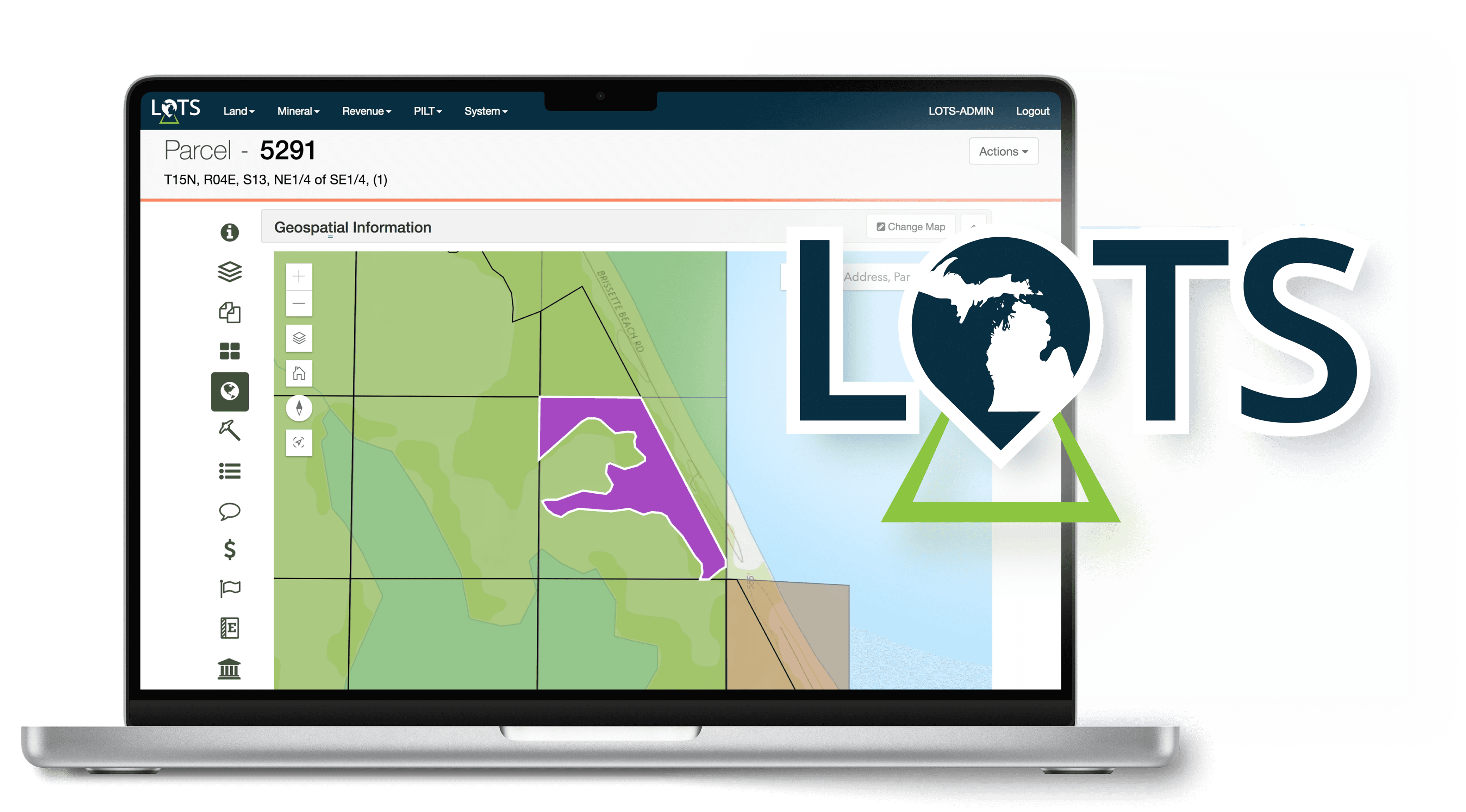
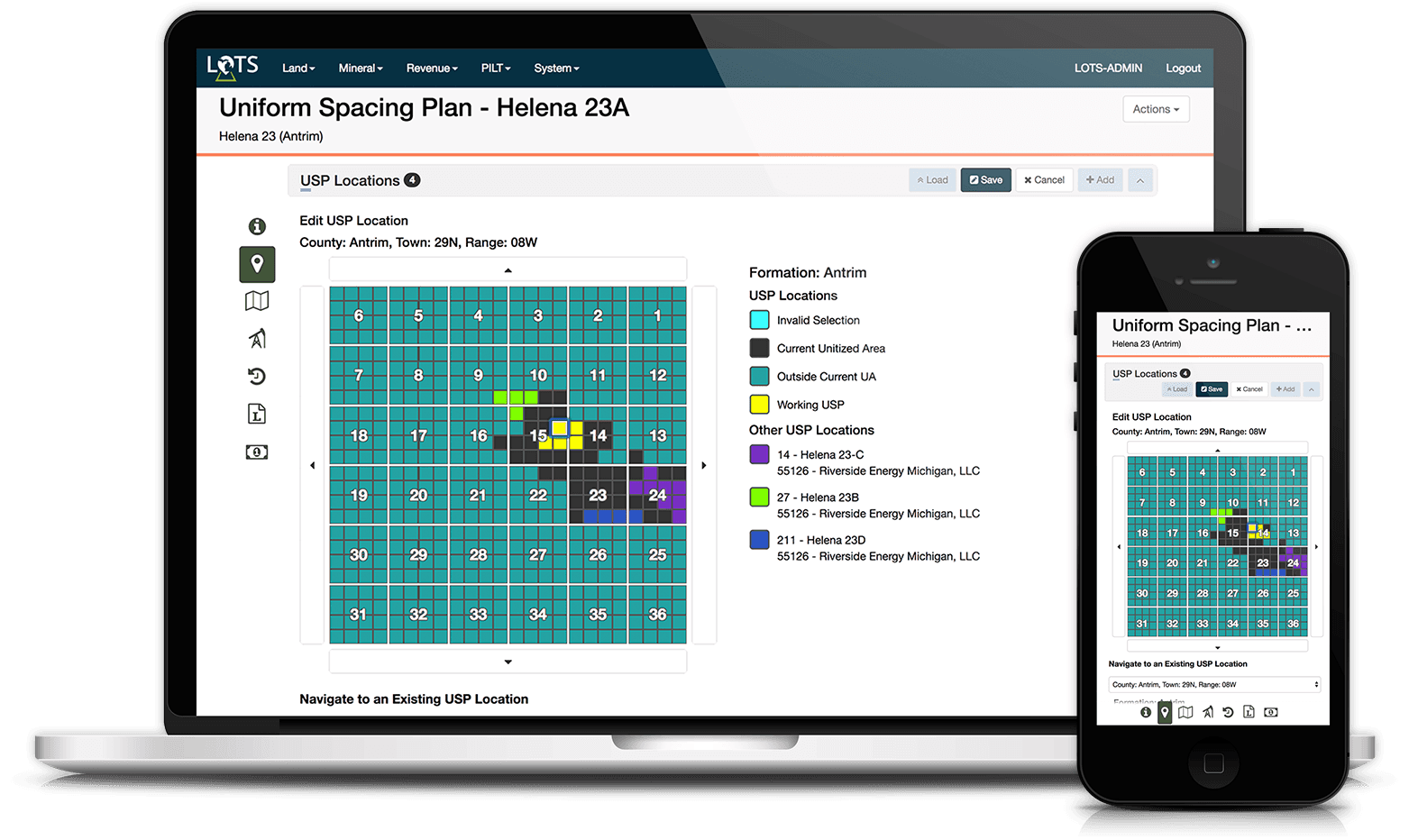
I set the platform’s UI standards and UX patterns, designed user interactions for complex land-management tasks, built custom interface components, and wrote the initial code for the ESRI ArcGIS mapping feature. I also created the LOTS logo and designed custom icons to match the Font Awesome set.
By bringing key data and workflows into LOTS, the project made the system more reliable, improved data transparency, and built trust. This directly supported land management decisions across Michigan.
LOTS by the Numbers
4.6 million acres of DNR-managed public lands
6.4 million acres of mineral rights
400+ staff users trained and registered during the initial rollout
~6,150 requirements and approximately 250 business rules
7 major integrations and related data connections
10+ platforms influenced by the reusable enterprise-search framework
Supporting the Stewardship of Michigan’s Public Lands
LOTS became the main digital tool for managing land records at the Michigan Department of Natural Resources. The update also helped the DNR move forward with its Public Land Strategy, which focused on using data to make decisions, better technology, responsible resource management, and more transparency in land decisions.
The platform helped the Real Estate and Minerals Management teams keep parcel records, track ownership history, manage land deals, document easements, handle mineral leases and auctions, distribute revenue, and make sure land decisions were based on up-to-date information.
The data also supported teams in Forest, Parks, Wildlife, Fisheries, GIS, field offices, and law enforcement. DNR staff needed reliable parcel information from offices all over Michigan, including both the Upper and Lower Peninsulas. Sometimes, users had to check land ownership or restrictions while out in the field.
LOTS was built to handle hundreds of users at once. It helped staff see not just where a parcel was, but also its history, legal details, mineral rights, active leases, conservation factors, and how it related to nearby land.
Replacing a Fragile Legacy Environment
The core legacy LOTS application was approximately 15 years old and ran only on an unsupported version of Windows. Important functionality was also distributed across several related applications, databases, and batch processes.
Staff often had to move between systems such as the Land Auction System (LAS), Field Review System (FRS), Swamp Tax, Payment in Lieu of Taxes (PILT), and the precursor to the Vegetative Management System (VMS). Many of these tools relied on database connections, nightly batch jobs, duplicate entry, or manual reconciliation to keep information aligned.
The legacy environment also contained usability challenges. When fields were unavailable, users sometimes stored valuable information in free-text comments. Different groups could work from different data sets. Related records were difficult to review together. Some processes required staff to consult paper archives or manually confirm information across multiple systems.
The modernization made the system more unified and lowered the chance that important details about ownership, leasing, or parcel history would be hard to find during land-management decisions.
Making Permissions Easier to Understand
One of the biggest improvements was making the system’s permission model easier to use.
The legacy interface displayed most fields as editable inputs, even when a user lacked permission to update them. A user could change information and click Save, only to discover that some edits had silently been discarded. The interface did not clearly distinguish between information a user could view and information they could modify.
The underlying permission structure was also difficult to administer. Access was configured at a highly granular field level, with separate permissions to view, edit, or clear individual fields. Setting up a new account could require hours of testing with the user to confirm that the configuration worked as intended.
The modern LOTS interface introduced clearer view and edit states. When users viewed a record, the interface presented the information in a readable format rather than a wall of input fields. When they entered edit mode, only the fields they were allowed to update appeared as editable controls. Read-only information remained visible when it provided useful context.
After a successful save, the system returned users to the view state, giving them a clear visual confirmation that their updates had been recorded. The result was a more understandable, predictable, and trustworthy experience.
Designing a Search Framework That Could Scale
Finding the right parcel quickly was one of the most important goals of the modernization.
The search feature also helped the DNR use data more effectively to manage public lands. By letting staff use flexible search options with up-to-date parcel records and GIS maps, LOTS made it easier to look at land locations, compare parcels, and make decisions with a fuller view of ownership, leases, and related records.
The legacy tools offered limited search options and returned large tables that users had to review manually. Staff could not easily see where a parcel was located, compare nearby parcels, or visualize search results on a map.
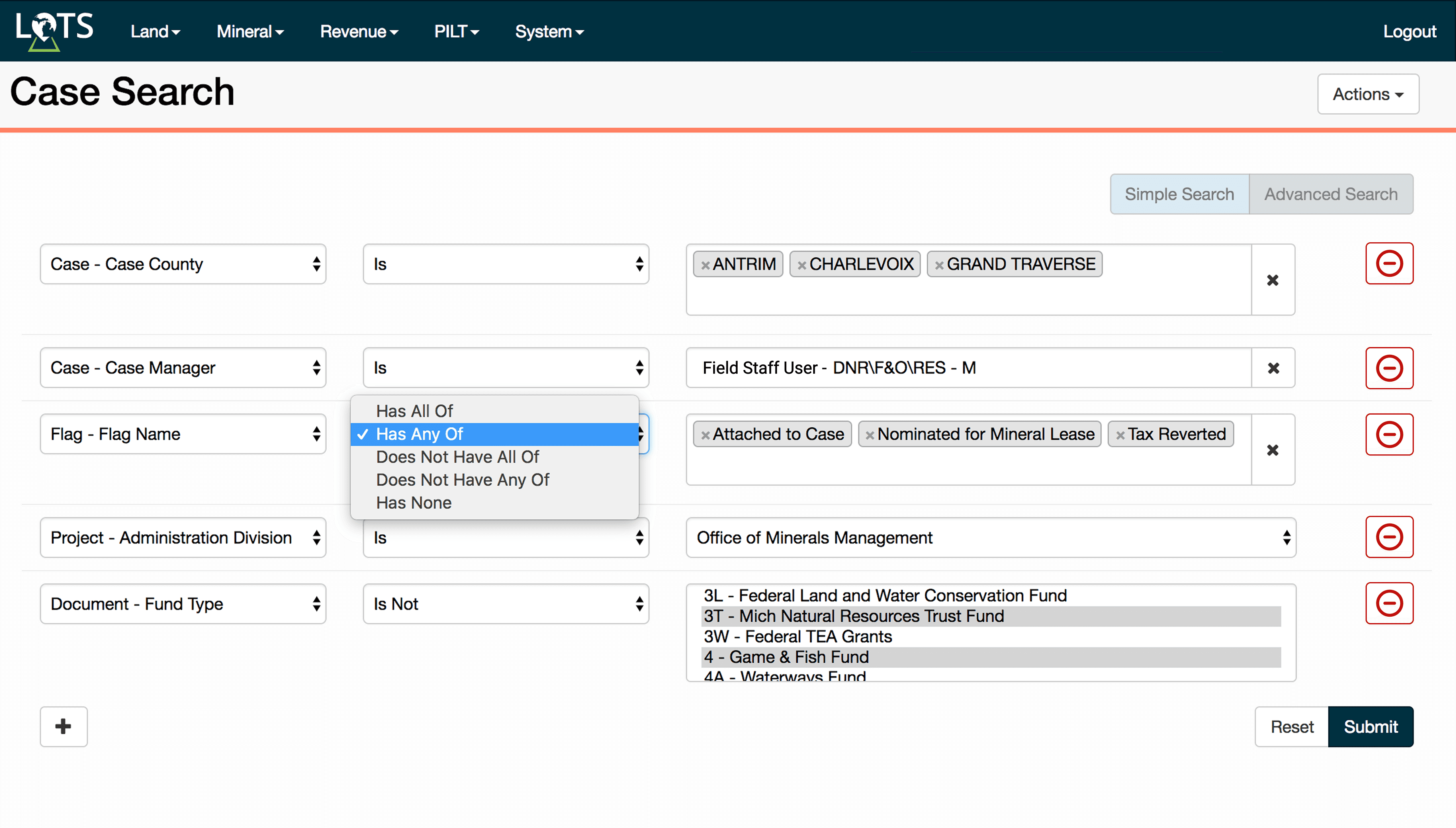
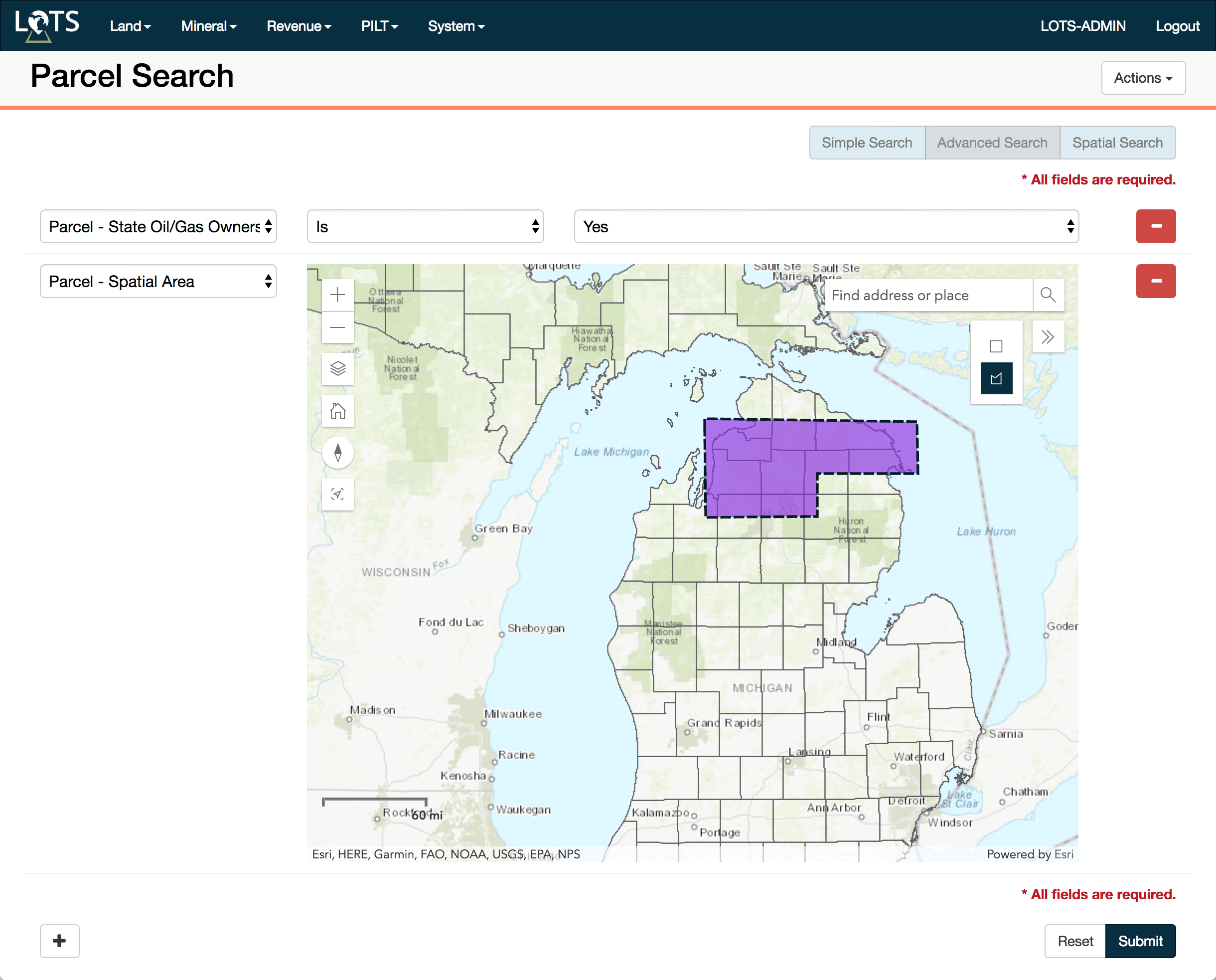
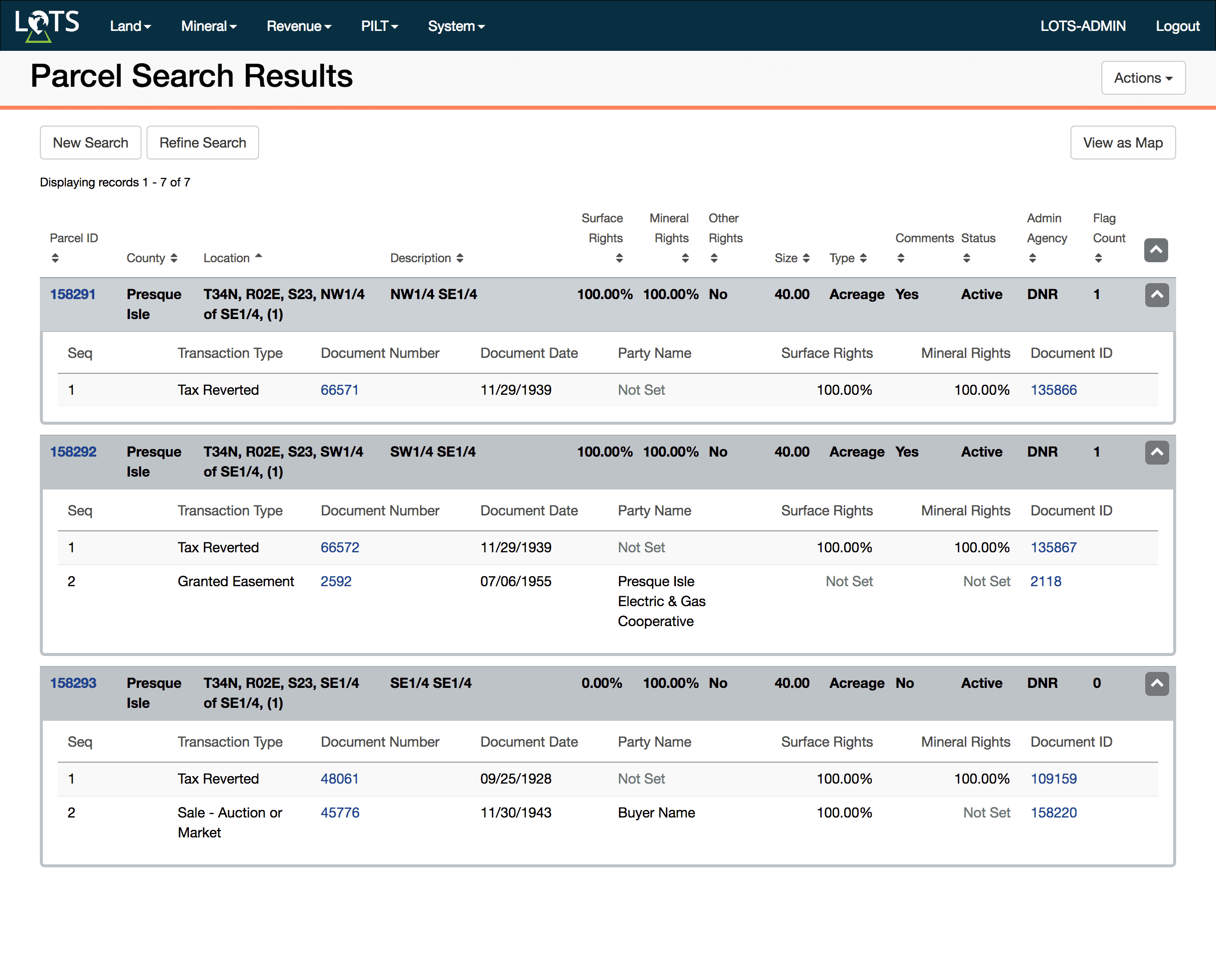
I designed and helped architect a new enterprise search framework that enabled users to combine any number of search parameters, including parcel IDs, Public Land Survey System regions, counties, dates, ownership details, lease information, and other record attributes.
The interface supported positive and negative search operators, such as Is and Is Not, allowing users to define complex queries that read naturally. A user could narrow a large set of records to a more meaningful result, such as parcels in a specific county that had not been purchased recently and did not have active mineral leases.
Users could also:
Enter multiple values for the same search field.
Select from around 100 additional search fields.
Choose field-aware search operators that allowed complex queries to be easily created.
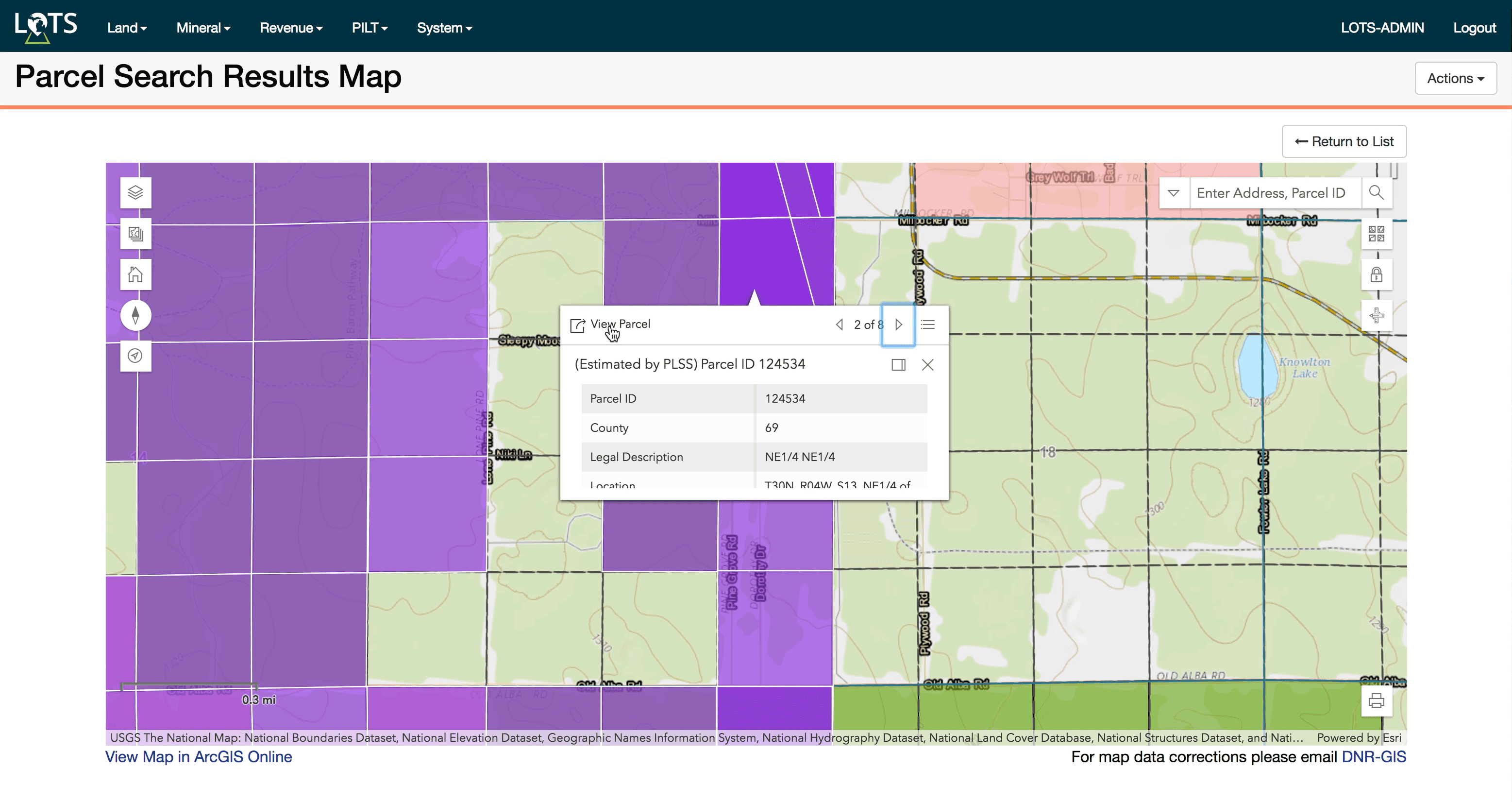
View results in a table or on an interactive ESRI ArcGIS web map.
See nearby parcels and related geographic context.
Select map results and open parcel details directly in LOTS.
Bookmark or share a unique search URL.
Save commonly used searches to a dashboard.
The search experience was designed with security in mind from the beginning. Results were permission-aware, so the system returned only the Parcel and Document records available to the current user. When one person shared a search URL with another user, the search parameters remained the same, but the result set was regenerated using the receiving user’s permissions and the most current system data.
The framework later became a reusable KL&A platform capability and influenced advanced search experiences across more than ten State of Michigan systems, including LPS, VMS, FIRST, INTELS, MAEAP, MiEDWIS, MSP CAP, and FirePC.
Bringing Parcel History into One Usable View
The updated parcel-detail view helped users see all the important information in one place without clicking through multiple screens.
Each parcel page brought together information such as:
Ownership and acquisition history
Public Land Survey System data
Mapping and GIS context
Mineral rights and active leases
Well locations and related environmental context
Conservation districts
Easements
Audit history and changes over time
The interface showed information in vertical sections that loaded asynchronously based on each user’s permissions and preferences. Users could open or close the sections they needed, and the platform remembered their choices as they moved between records.
Parcel pages loaded in about a third of a second, so users could move through search results quickly. Keyboard shortcuts and a consistent layout made it easier to review several parcels without losing track.
This design also worked well across different devices, so staff could access land information on small screens in the field or on larger desktop computers.
Connecting Maps, Records, and Related Systems
Mapping was central to the LOTS experience.
I wrote the initial code for the ESRI ArcGIS mapping feature and worked with the development team to integrate geographic information into the platform’s search and parcel-detail features.
Users could view search results on an interactive map, select parcels directly from the map, and open related records without leaving the LOTS experience. The platform also created GIS data views that enabled related state systems to access current parcel, ownership, leasing, and land management information.
The system connected with tools and data flows including:
Vegetative Management System (VMS)
Land Auction System (LAS)
Field Review System (FRS)
MiCaRS
SSRS
Data warehouse reporting
ArcGIS layer exports
Related workflows also used environmental context such as water-well information and watershed mapping from EGLE data sources.
These integrations turned LOTS into a trusted source for land information, not just another stand-alone tool.
Streamlining Mineral Rights, Auctions, and Legal Documents
The DNR’s Minerals Management team needed to manage leases, auctions, royalties, revenue distribution, surface-use agreements, and related legal documentation for state-owned land and mineral rights.
During periods of increased mineral-leasing activity, legacy tools struggled to support the volume and complexity of transactions. Some reports and documents required manual database queries, spreadsheet work, and Word formatting.
One especially complex task was preparing annual land-auction documents. The old process made users manually query two Access databases and format the results into a document that could be nearly 1,000 pages long.
LOTS changed this into a simple, repeatable process. Staff could create the document with one click, check the data, make corrections, and regenerate both the document and the auction-site export without having to rebuild everything by hand.
The platform also rebuilt calculations that were hidden in the old Payment in Lieu of Taxes (PILT) tool. Now, these calculations are easier to manage and update, so administrators can handle them more effectively in the future.
Supporting More Informed Land-Portfolio Decisions
The DNR’s Public Land Strategy called for a thoughtful approach to evaluating which lands should remain in state ownership, which parcels could be exchanged or transferred, and where acquisitions could strengthen public access, conservation, or long-term land management.
LOTS didn’t make those decisions for staff, but it gave them better information to make responsible choices.
By bringing together ownership history, acquisition records, GIS context, adjoining parcels, easements, mineral rights, active leases, and supporting documents, LOTS helped Real Estate and Minerals Management staff evaluate parcels with a more complete understanding of their history and constraints.
Teams could also share searches, making it easier to review parcels together, coordinate decisions, create reports, and check if mineral or surface-use rights needed to be considered before selling or transferring a property.
Strengthening Requirements, Testing, and Traceability
LOTS was a large and complex modernization effort. The final solution included approximately 6,150 requirements and 250 business rules.
During the discovery phase, the team found rules, workflows, and integration needs that hadn’t been documented before. This included about 100 business rules that needed to be documented and verified, plus a large portion of the Minerals Management features that had to be added.
I helped set up better ways to write user stories, define acceptance criteria, test, track progress, and design. Our team included five business analysts, a test manager, a project manager, and about 15-18 developers.
Requirements, stories, approvals, defects, and test cases were connected through Jira and Jama. Each test was completed by two or more users, and issues could be traced back to the related user story and, ultimately, to the original requirement or business rule.
The implementation also preserved the legacy data model, allowing portions of the desktop system and the modern web application to operate against the same underlying data during incremental rollout. This allowed the DNR to modernize carefully without forcing an all-at-once transition.
Improving Accessibility and Statewide Access
The legacy desktop application did not meet modern accessibility expectations.
The new LOTS platform met WCAG 2.0 Level AA standards, worked on different screen sizes, supported keyboard use, and had clear content and predictable actions. Staff could use it on any device, whether at their desk or out in the field.
The state trained expert users first, who then helped train others. During the rollout, staff quickly got used to the new navigation and search. They could easily see where they were in the system, if they could edit information, and if their changes were saved.
Supporting Better Land-Management Decisions
LOTS gave the Michigan Department of Natural Resources a stronger digital base for managing public lands and reaching its long-term stewardship goals.
By bringing together different tools, improving search, adding mapping, clarifying permissions, automating complex documents, and making the interface easier to use, the platform helped staff work more confidently.
The modernization also helped the DNR’s Public Land Strategy by making land information easier to find, compare, map, share, and keep up to date. Staff had better tools to review acquisitions, disposals, exchanges, leases, mineral rights, and other decisions that shape Michigan’s public lands.
LOTS also created value for the public. GIS exports let the DNR share up-to-date mapping data through the state’s open-data portal, making information about public lands, leases, easements, and conservation more transparent.
The modernization made it easier to keep land records up to date and gave staff a better base for making careful decisions about property, mineral rights, land use, and stewardship across Michigan.