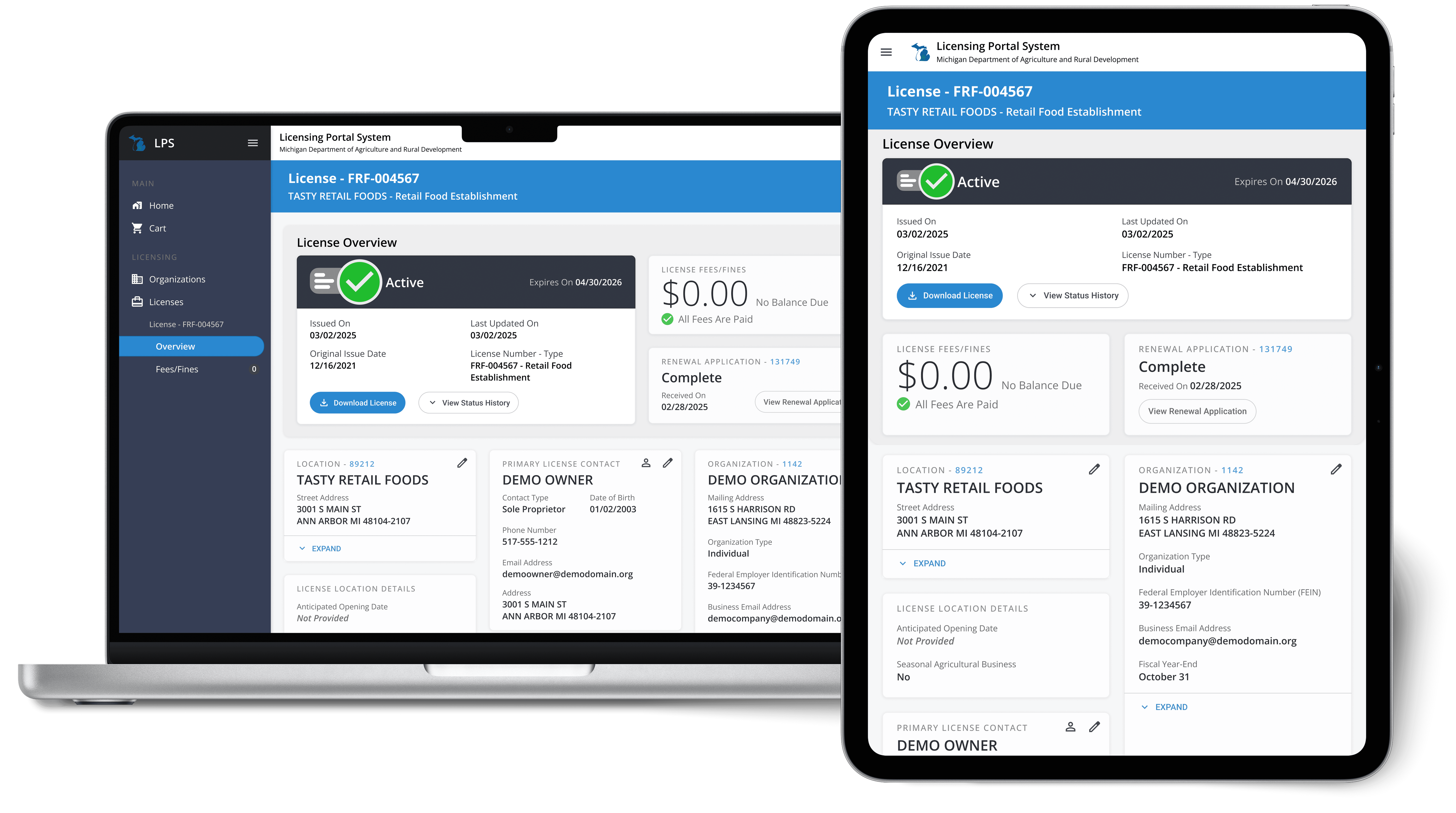
Design Decisions that Shaped the MDARD Licensing Portal Solution
The Licensing Portal Solution (LPS) was created to update and improve how the Michigan Department of Agriculture and Rural Development handles licensing across an array of program areas and divisions.
Instead of just copying old licensing processes into a digital format, the system was built with specific design choices to make things easier for staff, improve efficiency, and offer better digital services for both businesses and state employees.
The following key design decisions shaped the LPS platform's operation:

Capture Only the Minimum Required Data
Decision: The system should capture only the information necessary to issue and manage a license.
Older licensing tools included extra fields that slowed users down and complicated data management. LPS was designed to limit the collection of information to what is required by law, rules, or the minimum required to operate.
Impact
Faster application completion
Fewer applicant errors
Reduced staff review time
Decreased long-term data maintenance costs
This concept was used for every public-facing form in the platform.

Allow Users to Maintain Their Own Information
Decision: Applicants and license holders should be able to update core information, including names, addresses, and contact details, whenever possible.
In the past, staff had to make these changes, which added extra work and caused delays. Paper renewal forms previously didn’t allow users to make edits, but savvy licensees would cross out information and write changes in the margins.
Impact
Improved long-term data validity
Reduced support requests
Increased user ownership of records
This allowed limits on updates to be put in place only when needed to prevent license transfers, or to follow rules or meet audit requirements.

Collect Information Once and Reuse It
Decision: Applicants should never need to re-enter the same information.
Many businesses have more than one license at the same address. LPS lets organizations, locations, and contacts be reused in different applications.
Impact
Reduced application effort
Improved information consistency
Fewer redundant records across licensing programs
This choice was especially helpful for businesses that are licensed by more than one MDARD division. For example, food establishments, motor-fuel retail, and nursery dealers could all be licensed at a single grocery store location or outlot.

Design for Self-Service
Decision: The licensing system was built so applicants can complete most tasks on their own, without needing staff assistance.
Applications include guided workflows, clear validation rules, and automated feedback when corrections are required.
Impact
Reduced phone and email inquiries
Faster application completion
Improved user experience
This allowed staff to remain available to assist users, but the system was designed to support the successful completion of licensing tasks. Freeing up staff time to allow better exchanges and user support.

Use Similar Interfaces for Public and Internal Users
Decision: Internal staff interfaces should closely mirror the public portal's user experience.
This design allows staff to easily replicate the steps that applicants take when assisting them.
Impact
Simplified support interactions
Faster issue resolution
Reduced training requirements for licensing staff
This approach also reduced software development complexity by reducing duplicated functionality.ATE

Build a Platform, Not a Single Program Solution
Decision: The system should support multiple license types across different license program areas.
Rather than creating separate systems for each division, LPS was designed as a configurable licensing platform.
Impact
Shared licensing workflows
Consistent user experience across programs
Reduced system duplication across MDARD divisions
This architecture allows additional license types to be added in the future.

Favor Configuration Over Custom Development
Decision: Licensing rules, workflows, and application forms were made to be adjustable whenever possible.
Instead of hardcoding program-specific rules, the system lets authorized staff configure features such as licensing, application workflows, renewal dates, validation rules, and fee structures.
Impact
Faster onboarding of new licensing programs
Lower development costs
More flexibility when regulatory rules change
This pattern limits costs to the state and improves response times for changes requested at the discretion of lawmakers and department directors.

Automate Routine Licensing Processes
Decision: When rules allow, licensing tasks are automated.
The approval of an application should require minimal processing; credentials should be issued automatically; payments should trigger item transitions through workflows; and licensees should be notified when renewals are available online.
Impact
Decreased manual processing and response times
Faster licensing turnaround
More consistent processing workflows
For licenses that do not need inspections, they can often be issued soon after payment and validation in an average of under 2 days.

Design for Accessibility from the Start
Decision: Accessibility was a key part of the design from the start, not just something added later to meet rules.
The user interfaces were built to meet WCAG level AA accessibility standards, including the following high-level considerations: keyboard navigation, screen reader access, color contrast, and text zoom.
Impact
Accessible services for users with disabilities
Compliance with federal and state accessibility standards
Improved usability for all users
This allows the MDARD Licensing Portal System to support all individuals.

. Support Both Businesses & MDARD Staff
Decision: The licensing platform must support the needs of both licensed businesses and MDARD staff responsible for administering licensing across the various program areas.
While external users require simple, guided application experiences, internal staff need tools to review applications, manage workflows, issue credentials, and monitor compliance.
Impact
Improved transparency for applicants
Streamlined licensing workflows for staff
Better support for users across program areas
This system was built to balance: Streamlined self-service interfaces and workflows for businesses, administrative tools for licensing specialists and program staff, and shared visibility into application status and licensing data using identical interfaces.

Maintain Full Requirements Traceability
Decision: All functional and non-functional requirements should be fully traceable through development and testing.
Procurement documentation, regulatory requirements, and stakeholder needs were transformed into a structured backlog with traceability between requirements, user stories, test cases, and release documentation.
Impact
Complete test coverage of all functional requirements
Improved defect tracking
Strong audit readiness
This traceability model also supported automated documentation generation for system deliverables.

Deliver Incrementally Through Agile Releases
Decision: The platform would be implemented as multiple iterative Agile releases/deployments rather than a single large release.
Licensing program areas were onboarded incrementally, allowing workflows and system capabilities to evolve based on operational feedback and needs.
Impact
Reduced implementation risk
Faster delivery of usable features
Continuous improvement of licensing workflows
This implementation strategy allowed LPS to replace costly legacy systems incrementally, in the order requested by MDARD.
Summary
The Licensing Portal System (LPS) represents a shift from fragmented licensing tools toward a unified digital licensing platform for MDARD.
By focusing on minimal data collection, reusable information, self-service workflows, and configurable architecture, the system improves the experience for both licensed businesses and the state staff responsible for administering licenses.
These design decisions helped ensure that the platform could evolve while keeping consistent, efficient licensing operations.